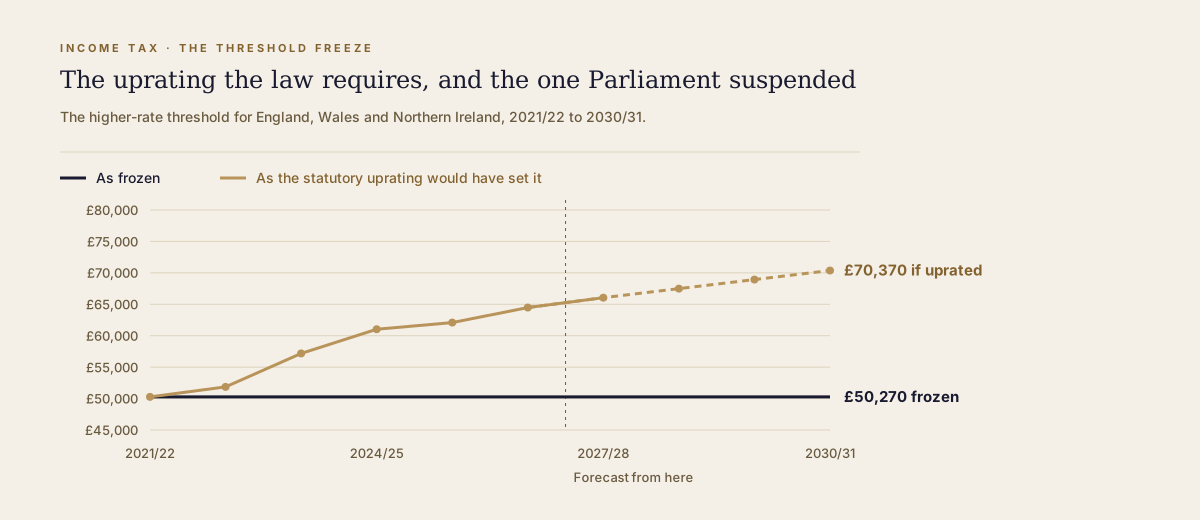
The income tax threshold freeze is the suspension of the statutory duty to raise the personal allowance and the basic rate limit in line with inflation each April, in force from 2022/23 until April 2031. Since 2022/23 the personal allowance has stayed at £12,570 and the higher-rate threshold at £50,270, so each April more of the same real income falls into tax. Parliament did not raise a rate to do this: it suspended a duty in the Income Tax Act 2007 that would otherwise have moved both figures in line with September's inflation, which is why the change draws less attention than a rate rise of the same size. The suspension runs to 5 April 2031, and a freeze ending is not the same thing as the thresholds going up.
Every April the personal allowance is supposed to go up. Not as a matter of political generosity but as a matter of statutory duty: the Income Tax Act 2007 tells the Treasury it must raise the allowance in line with prices, and sets out exactly how to do the sum. Since 2022/23 that duty has been switched off, and the switch stays off until April 2031.
How does the income tax threshold freeze work?
Sections 21 and 57 of the Income Tax Act 2007 require the personal allowance and the basic rate limit to rise each April in line with the September consumer prices index. Successive Finance Acts have disapplied both provisions, most recently to 5 April 2031, so the figures stay fixed in cash terms while prices and pay rise around them.
The duty, and the suspension of it
Two sections do the work. Section 57 governs the personal allowance: it compares the consumer prices index for the September before a tax year with the September before that, raises the allowance by the same percentage, and rounds the result up to the nearest £10. Section 21 does the same for the basic rate limit, the slice of taxable income charged at the basic rate, rounding up to the nearest £100 instead. Add the two together and you have the point at which higher rate tax begins.
Section 57 is not permissive. It says HM Treasury must make the order before the tax year starts.
What has happened since 2021 is that each Finance Act has disapplied both sections for a further run of years. The allowance rose to £12,570 for 2021/22 and has not moved since; the higher-rate threshold has stood at £50,270 across the same period. The most recent extension, confirmed at the Autumn Budget in November 2025, carries the freeze to 5 April 2031.
This is worth being precise about because it changes what kind of thing the freeze is. No rate went up. Nothing was withdrawn. A duty that would have moved two numbers was set aside, and the numbers stayed where they were.
Why a pay rise that matches inflation still costs you
Suppose prices rise 3% and your salary rises 3%. In what your money buys you are exactly where you started. But the point at which the 40% rate begins has not moved, so a larger slice of that same real income now sits above it. Your average rate of tax rises while your standard of living does not.
That is the entire mechanism. No rate had to change and no announcement had to be made: a pay rise that only keeps up with prices is enough to do it.
What the freeze does to a £61,400 salary in 2026/27
Marcus earns £61,400, all of it salary, and pays income tax in England. His pay has risen roughly in line with prices since 2021/22.
| Input | Value |
|---|---|
| Personal allowance, as frozen | £12,570 |
| Higher-rate threshold, as frozen | £50,270 |
| Personal allowance, had section 57 run | £16,080 |
| Higher-rate threshold, had sections 21 and 57 run | £64,480 |
- On the frozen thresholds, £61,400 produces an income tax bill of £11,992.
- Had both sections run as enacted, the same salary would sit entirely below the higher-rate threshold of £64,480, and the bill would be £9,064.
- The difference, £2,928, is what suspending the indexation duty costs Marcus in 2026/27 alone.
Result: Marcus pays £2,928 more in 2026/27 than the statutory uprating would have left him paying, on an income that would not have reached the higher rate at all had the thresholds moved as the law requires.
The uprated figures in that box are not a guess about what a Chancellor might have chosen. They are the output of the arithmetic sections 21 and 57 set out, run on the September index values the Office for National Statistics published, for each year the sections were disapplied.
Where the freeze does the most damage
A frozen threshold is worst where the income around it is already taxed at an unusual rate, because the freeze pushes people into those zones and then keeps them there.
The clearest case is the £100,000 point at which the personal allowance starts to be withdrawn. That figure has not moved since 2010, which makes it the longest-frozen threshold in the income tax system by a wide margin, and the band above it carries an effective marginal rate far above the headline additional rate. Someone whose pay has merely kept pace with prices since 2010 can find themselves inside it having gained nothing in real terms. The 60% tax trap is that band, and the freeze is what keeps feeding people into it.
The second case is quieter. Crossing the higher-rate threshold does more than change the rate on the top slice of income: it halves the personal savings allowance, from £1,000 to £500. Someone dragged over the line by a cost-of-living pay rise loses half that allowance in the same step, so a single crossing raises the tax on their earnings and on any savings interest they hold.
No Finance Act has ever frozen the point at which the additional rate starts. It is frozen anyway. Section 10 of the same Act gives that rate no figure of its own: it charges the additional rate on income above the higher rate limit, and defines that limit as twice the personal allowance plus the income at which the allowance begins to be withdrawn. Twice £12,570 plus £100,000 is £125,140, which is where the additional rate begins. Freeze the allowance and the formula holds this figure still along with it.
Section 10 also kept a duty that sections 21 and 57 lost: the Treasury must still make an order before each tax year specifying what the higher rate limit is. That order is still made. It names the same figure as the year before, because the allowance it is calculated from has not moved. Had section 57 run, the allowance would stand at £16,080 for 2026/27 and the additional rate would begin at £132,160, so the £7,020 between those two figures is income charged at 45% that would have been charged at 40%.
Scotland has half of this
The personal allowance is reserved to Westminster, so a Scottish taxpayer’s allowance is frozen at £12,570 exactly like everyone else’s. The rates and bands that tax their earnings are not: Holyrood sets those annually, and there is no equivalent indexation duty in Scottish legislation for a Finance Act to disapply.
So a Scottish taxpayer carries the allowance half of the freeze and not the band half. That makes their exposure smaller and harder to state, because what the frozen allowance costs them depends on the Scottish rate that applies at their income, and that rate has changed more than once during the freeze.
Risk warning
HM Revenue and Customs practice and the law relating to taxation are complex and subject to individual circumstances and changes which cannot be foreseen.
Working out your own number
The size of the effect depends almost entirely on where your salary sits relative to the frozen thresholds, which is why a single headline figure for “the average taxpayer” tells you very little about your own position. Someone just below the higher-rate threshold and someone well above it are affected by quite different amounts. Above £132,160 the personal allowance has gone under the frozen figures and under the uprated ones alike, so past that point the freeze reaches you through the band edges alone.
Knowing the number is not the same as knowing what to do about it, and the two levers that reduce it both cost something other than money. A pension contribution puts the money beyond reach until age 55, rising to 57 from 6 April 2028, which is a long time to commit capital you might need for something else first. Salary sacrifice reduces the gross salary that a mortgage lender will lend against and that a death-in-service benefit is usually a multiple of, so it can quietly shrink two things you were relying on. Neither is a reason not to use them. They are the reason the affordability question comes before the tax one.
Risk warnings
Pensions
The value of pensions and any income from them can fall as well as rise. You may not get back the full amount invested.
Levels and bases of, and reliefs from, taxation are subject to change and their value will depend upon personal circumstances. Taxation and pension legislation may change in the future.
A pension is a long-term investment and the value is not guaranteed. Any advice or considerations are personal to each individual’s circumstances.
Salary sacrifice
It is important to note that salary sacrifice is not suitable for all employees. Employees’ pre-tax salary will be reduced. This may affect their entitlement to State Benefits.
Mortgage lenders may calculate borrowing amounts in terms of the reduced salary.
Life cover or income protection policies may pay out on a multiple of salary. This may be less if salary is sacrificed.
Mortgages
Your home may be repossessed if you do not keep up repayments on your mortgage. Think carefully before securing debts against your home.
Not all mortgage contracts are regulated by the Financial Conduct Authority.
What actually happens in April 2031
Nothing, unless a government decides otherwise, and that is the part most coverage of the end date gets wrong.
A freeze ending does not mean the thresholds rise. It means the suspension lapses and the indexation duty in sections 21 and 57 comes back into force, which would raise the figures from wherever they then stand. But three Finance Acts have already extended this freeze, and a fourth could extend it again before 2031 arrives. The date is the end of the current commitment rather than a scheduled increase, and it belongs in a plan as the former.
That distinction matters more than it sounds. If you are modelling what your income looks like in the 2030s, the honest assumption is not that thresholds resume rising in 2031, and it is not that they stay frozen forever either. It is that this is a policy lever which has been pulled repeatedly, and a plan that only works if it stops being pulled is a plan with a single point of failure in it. The timetable of dated changes to 2031 sets out what else is already fixed for the same period.
Frequently asked questions
What is the income tax threshold freeze?
It is the suspension of an indexation duty, not a new tax. Sections 21 and 57 of the Income Tax Act 2007 require the Treasury to raise the basic rate limit and the personal allowance in line with the September consumer prices index before each tax year begins. Successive Finance Acts have disapplied both, most recently to 5 April 2031, so the figures stay where they are while prices move.
How does a frozen threshold raise my tax when the rate has not changed?
Because the rate applies to a larger share of your income. If prices and your pay both rise 3% you are no better off in what your money buys, but the point at which 40% starts has not moved, so more of that same real income sits above it. The reverse is worth knowing too: if your pay is flat in cash terms the freeze costs you no extra tax at all, and you still lose in real terms, because prices moved and your pay did not.
Does the freeze affect Scottish taxpayers?
Partly. The personal allowance is reserved to Westminster, so it is frozen at £12,570 for a Scottish taxpayer exactly as it is everywhere else. The Scottish rates and bands are set at Holyrood each year and carry no equivalent indexation duty, so there is nothing there to suspend. One consequence catches people out: the personal savings allowance is also reserved, so it is judged against the UK higher-rate threshold of £50,270 rather than the Scottish one. Someone paying the Scottish higher rate from £43,662 keeps the full £1,000 until their income passes the UK threshold, and drops to £500 above it like everyone else.
Do the thresholds go up automatically in April 2031?
No. The freeze ending means only that the suspension lapses, and the indexation duty resumes from wherever the thresholds then stand, so nothing is recovered for the years it was suspended. A future Finance Act could also extend the freeze again, as three have already. Treat April 2031 as the date the current commitment runs out rather than as a scheduled increase.
Has the personal allowance really not moved since 2021?
It rose to £12,570 for 2021/22 and has stayed there every year since. That is the longest it has been held in cash terms since the allowance began rising annually, and it is why the freeze is sometimes described as a stealth tax: nothing was announced in the year it took effect, because the change is the absence of an announcement.
Can I do anything about being dragged into a higher band?
A gross pension contribution and a Gift Aid donation both reduce adjusted net income, which is the measure the £100,000 taper is tested against, and salary sacrifice reduces gross pay before it is ever taxed. Each has a cost beyond the money. Pension contributions are locked until age 55, rising to 57 from 6 April 2028, and salary sacrifice lowers the salary a mortgage lender and a death-in-service multiple are both calculated from. Whether any of them is the right use of the money is a different question from whether they work.
Risk warning
Employees earning more than £260,000 with a tapered annual allowance may incur additional annual allowance tax charges.