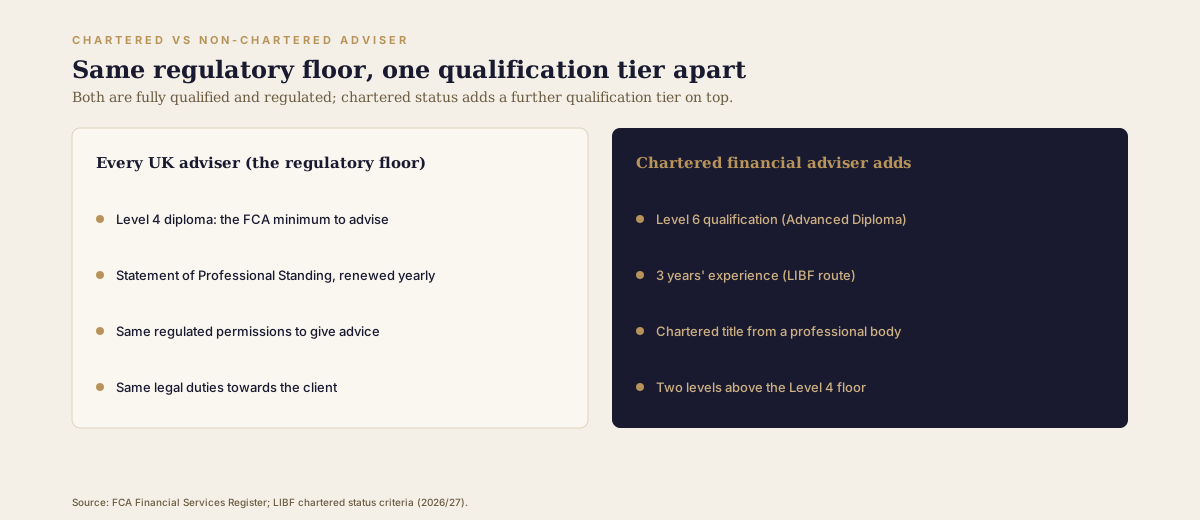
A chartered financial adviser is one who has been awarded chartered status by a professional body for reaching a Level 6 qualification and meeting its experience requirements. Chartered status signals technical depth above the minimum bar, but not independence or suitability, so treat it as one quality marker among several rather than a guarantee of better advice. It reflects Level 6 qualification and further experience, sitting above the Level 4 diploma that every UK adviser must hold to give regulated advice. The title does not show whether an adviser is independent or holds the specialist permissions a particular case needs.
A chartered financial adviser has qualified to Level 6 and earned chartered status from a professional body, a tier above the minimum every UK adviser must reach to give regulated advice. The practical difference between a chartered adviser and one who is not comes down to qualification depth and proven experience, not whether either is allowed to advise you. Both are fully qualified and regulated. The chartered title is widely treated as a gold standard, and it is a genuine marker of expertise, but it is also widely misunderstood. The qualification requirements and chartered titles described here reflect the rules in place for the 2026/27 tax year.
How does a financial adviser become chartered?
An adviser becomes chartered by qualifying to Level 6, for example through the CII Advanced Diploma in Financial Planning or the LIBF Advanced Diploma in Financial Advice, and then meeting the awarding body’s further criteria. With the CII that means at least five years’ sector experience, which can include time before qualifying. Other bodies set their own experience requirements.
Contents
- What is a chartered financial adviser?
- What actually differs between chartered and non-chartered advisers?
- Which bodies award chartered status?
- Is a non-chartered adviser less qualified?
- Is choosing a chartered financial adviser worth it?
- Chartered, certified or independent: what’s the difference?
- How do I check an adviser’s credentials and permissions?
What is a chartered financial adviser?
A chartered financial adviser holds chartered status, a professional designation awarded by a recognised body to advisers who have qualified to Level 6 and met the experience requirements that body sets. Through the Chartered Insurance Institute, the most common route, that means completing the Advanced Diploma in Financial Planning and holding at least five years’ sector experience, which earns the specific title of Chartered Financial Planner.
To put the level in context, Level 6 is broadly equivalent to a bachelor’s degree, and it sits two steps above the Level 4 diploma that is the legal minimum to give regulated advice in the UK. Reaching it usually takes several years of further study on top of qualifying.
Chartered status is best understood as a measure of how far an adviser has taken their formal qualifications, rather than a description of what they do day to day. The adviser you appoint shapes your whole financial plan, from how your pensions and investment strategy are structured to how those decisions interact years later, so depth of knowledge genuinely matters. What chartered status does not capture, as the rest of this article explains, is whether that adviser is the right fit for your particular situation.
Risk warnings
The value of pensions and any income from them can fall as well as rise. You may not get back the full amount invested.
A pension is a long-term investment and the value is not guaranteed. Any advice or considerations are personal to each individual’s circumstances.
A pension is a long-term investment, the value of your investment and the income from it may go down as well as up. Your eventual income may depend upon the size of the fund at retirement, future interest rates and tax legislation.
What actually differs between chartered and non-chartered advisers?
The difference between a chartered and a non-chartered adviser comes down to qualification level and experience, layered on top of an identical regulatory baseline. Every adviser who gives regulated advice in the UK must hold at least a Level 4 diploma, such as the Diploma in Regulated Financial Planning, and a current Statement of Professional Standing confirming they are qualified and keeping their knowledge up to date. That is the floor. A chartered adviser has built on it with a Level 6 qualification and the further experience their professional body requires.
The diagram shows four tiers of UK adviser qualifications for 2026/27, with Level 4 as the regulatory floor every adviser must clear and Level 6 marking chartered status, two full levels above that floor. Level 7, covering advanced specialist planning such as Certified Financial Planner, sits higher still, while anything below Level 4 is not sufficient to give regulated advice at all.
It is worth being clear about what does not separate the two, since this is widely misunderstood. Membership of a professional body, adherence to a code of ethics, and a yearly programme of continuing professional development are not chartered privileges: every adviser needs them to hold a Statement of Professional Standing, chartered or not. What chartered status adds is the higher qualification, the experience behind it, and a recognised title conferred by the body.
What it is not is a different licence to advise. A non-chartered adviser and a chartered one can sit across the table from you with the same regulatory permissions, the same ability to recommend products, and the same legal duties towards you. The chartered title shows the adviser has gone further with their qualifications. It does not, on its own, mean they will give you better advice, charge less, or be the right specialist for the decision in front of you.
Which bodies award chartered status?
Several professional bodies can award chartered status to advisers, and the exact title depends on which one. The best known is the Chartered Insurance Institute, working through its Personal Finance Society, which confers the Chartered Financial Planner title on individuals who complete the Advanced Diploma and meet the experience and membership criteria. The Privy Council authorised the institute to grant chartered titles in 2005, putting financial planners on a similar professional footing to chartered accountants and surveyors.
Can a financial advice firm be chartered, not just an individual adviser?
Yes. The Chartered Insurance Institute awards Corporate Chartered status to firms that meet its standards on qualifications, ethics and professional development, separate from any individual title. A firm can hold this status while employing advisers who are not personally chartered, so a chartered firm name does not guarantee every adviser inside it holds the individual title.
The Chartered Institute for Securities & Investment is another major body. It awards chartered membership designations, the Chartered Wealth Manager title for senior practitioners in the retail sector, and a Chartered Fellow (Financial Planning) designation for those at the highest planning standard. Its titles reflect the institute’s roots in investment and wealth management.
The London Institute of Banking & Finance is a third major route on the same footing. Its Advanced Diploma in Financial Advice is a full Level 6 financial planning qualification, and becoming chartered through the LIBF route requires at least three years’ relevant professional experience alongside it, a shorter experience bar than the CII’s five years even though the qualification level is the same.
The takeaway is that chartered is not a single badge from a single source. Two advisers can both be chartered while having qualified through different institutes, in different specialisms, against criteria that are similar in spirit but not identical.
Is a non-chartered adviser less qualified?
No, a non-chartered adviser is not unqualified, and treating the absence of the title as a warning sign would be a mistake. To give regulated advice in the UK, every adviser has to hold an approved Level 4 qualification and a Statement of Professional Standing, renewed each year by an accredited body. That is a degree-level benchmark covering investment principles, taxation, pensions, regulation, and the financial planning process. An adviser without chartered status has still cleared that bar.
Chartered status builds further qualification and experience on top of that benchmark, which is worth something, especially for complex planning. But plenty of capable advisers have chosen not to pursue it, are working towards it, or hold strong specialist qualifications in a single field such as pensions that matter more for the advice you need than a general chartered title would.
The more useful question is rarely whether an adviser is chartered in the abstract. It is whether their qualifications, specialisms, and permissions match the complexity of the plan you are trying to build, whether that is a straightforward review or something far more involved.
Risk warning
Levels and bases of, and reliefs from, taxation are subject to change and their value will depend upon personal circumstances. Taxation and pension legislation may change in the future.
Is choosing a chartered financial adviser worth it?
Choosing a chartered financial adviser is a reasonable thing to value as one part of how to choose a financial adviser, because the title is an independently verified signal that an adviser has invested heavily in their expertise. For broad, long-term planning, that reassurance has real worth. The trade-off is that chartered status is a general marker, and it can quietly crowd out the checks that matter more for a specific decision: whether the adviser is independent or restricted, what they charge, and whether they hold the particular permissions your situation requires.
That last point is where the visible credential and the useful credential can come apart. Some advice areas, defined benefit pension transfers in particular, require permissions and specialist qualifications that a chartered title does not include.
Raymond, 60, with a £480,000 transfer value
Raymond has a defined benefit pension with a transfer value of £480,000 and wants regulated advice on whether moving it to a personal pension would suit his plan. He approaches two advisers.
The first is a chartered financial adviser at a firm that does not hold the permission to advise on defined benefit transfers. The second is not chartered, but works at a firm that does hold that permission and is a qualified pension transfer specialist.
Only the second adviser can actually take Raymond’s case. The chartered title, by far the more visible credential, is not the one that decides who is allowed to help him. The specific permission, which is easy to overlook, is what determines the outcome.
So the honest answer is that chartered status belongs on your shortlist of criteria, but not at the top as the only one. It raises the floor on technical competence. It does not, by itself, confirm that an adviser is independent, affordable, or permitted to handle the specific decision you are bringing to them.
Chartered status is the profession’s most recognised mark of technical depth, but it has never been a substitute for checking that an adviser holds the specific permissions your decision actually requires.
Important information
We do not currently provide advice on transferring out of defined benefit (final salary) pension schemes. If you require this advice, we will provide details of a suitably qualified adviser at a firm with the necessary regulatory permissions who can assist you.
Chartered, certified or independent: what’s the difference?
Three labels get tangled together in people’s minds, but they describe completely different things. Chartered status is about qualification level. Independent versus restricted is about how much of the market an adviser can recommend from. Certified, as in Certified Financial Planner, is a separate certification again, focused on the discipline of building a complete financial plan.
The chartered and independent distinction is the one most often confused. An adviser can be chartered and restricted, meaning highly qualified but only able to recommend from a limited range of products. Another can be independent, surveying the whole market, without holding a chartered title. The two say nothing about each other, which is why it helps to understand the difference between restricted and independent advice separately from any qualification badge.
Certified Financial Planner sits in yet another box. It is a globally recognised certification, benchmarked at Level 7, that centres on comprehensive planning and building a lifetime cashflow projection rather than on a single technical subject, and in the UK it is licensed by the Chartered Institute for Securities & Investment. Some advisers hold both chartered and certified status; they are different marks, earned by different routes, signalling different things.
Read together, these labels describe an adviser from three angles: how qualified, how independent, and how planning-focused, and none on its own tells you the whole story.
How do I check an adviser’s credentials and permissions?
The most reliable way to check an adviser is to start with the regulator, not the letters on a business card. The Financial Conduct Authority’s Financial Services Register, and its firm checker tool, let you confirm that a firm and individual are authorised and, crucially, which regulated activities they are permitted to carry out. If a firm is not authorised for the advice you need, the qualifications behind it are beside the point.
For an individual adviser, the FCA’s published Directory Persons data shows their status and the firm they are attached to. You can verify a chartered title separately through the awarding body’s own register, such as the Personal Finance Society’s directory for Chartered Financial Planners.
Reading these sources together gives you the full picture: that the adviser is authorised, that they hold the permissions your decision requires, and that any chartered status they claim is genuine. It is a few minutes of checking that protects the foundations of your plan before you commit to anyone.
Is chartered status enough to choose an adviser on?
Chartered status is a meaningful signal and a fair thing to look for, but it is a starting filter, not a verdict on the advice you will receive. A chartered financial adviser has gone further than the minimum, which counts, yet independence, fees, specialism, and the right permissions all sit outside the title. The sensible approach is to judge an adviser on the full set, with the chartered mark as one input among several.
Frequently asked questions
What is a chartered financial adviser?
A chartered financial adviser has earned chartered status from a professional body, which requires a Level 6 qualification and a period of experience set by that body. It is widely regarded as a benchmark of professionalism. The title sits above the Level 4 standard that every UK adviser must already hold to advise.
How does an adviser become chartered?
An adviser becomes chartered by qualifying to Level 6, for example through the CII Advanced Diploma in Financial Planning or the LIBF Advanced Diploma in Financial Advice, and meeting the awarding body's further criteria. With the CII that means at least five years' sector experience, which can include time gained before qualifying.
Is a non-chartered financial adviser less qualified?
A non-chartered adviser is still fully qualified and regulated. Every UK adviser giving regulated advice must hold at least a Level 4 diploma and a current Statement of Professional Standing. Chartered status reflects further study and experience on top of that minimum, not whether an adviser can legally advise you.
Is it worth choosing a chartered financial adviser?
Chartered status is a reliable signal of technical depth and the experience behind it, so it can be reassuring for complex planning. However, it does not tell you whether an adviser is independent, what they charge, or whether they hold the specialist permissions your situation needs. Treat it as one useful filter rather than the only one.
What is the difference between a chartered financial adviser and a Certified Financial Planner?
Chartered status, such as Chartered Financial Planner from the CII, reflects a Level 6 qualification and experience. Certified Financial Planner (CFP) is a separate, globally recognised certification benchmarked at Level 7 that focuses on comprehensive financial planning. They are different marks from different bodies, and some advisers hold both.
Which professional bodies award chartered status to advisers?
Several do. The Chartered Insurance Institute awards Chartered Financial Planner status, the Chartered Institute for Securities & Investment awards titles such as Chartered Wealth Manager and Chartered Fellow, and the London Institute of Banking & Finance offers a route to chartered status. Each body sets its own criteria.