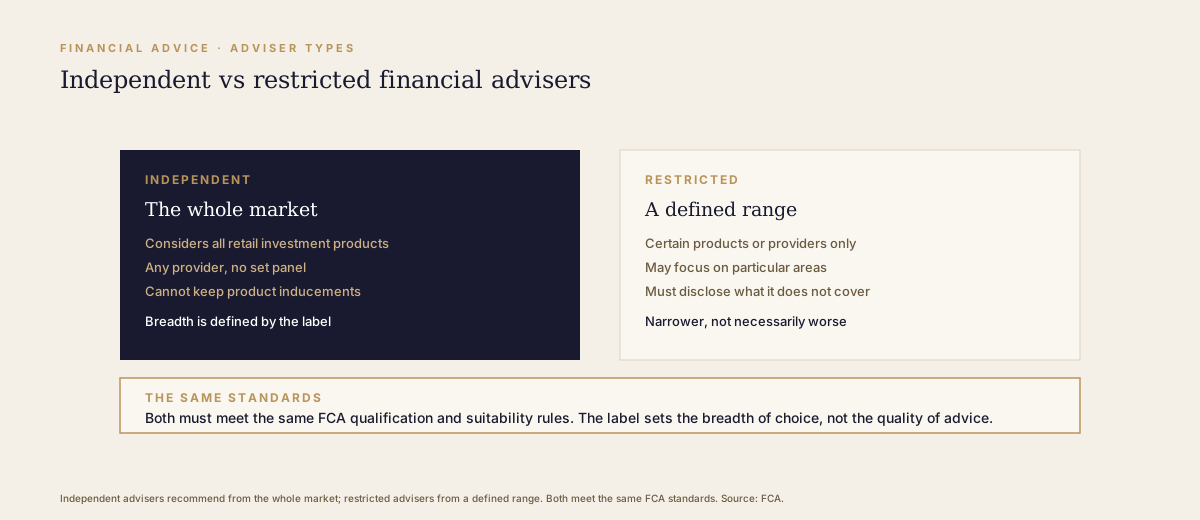
Independent and restricted advice are the two regulatory categories of UK financial adviser, defined by the FCA according to how wide a range of retail investment products the adviser is permitted to recommend. The label matters less than people assume: independent status brings whole-of-market breadth and bars the adviser from keeping product inducements, but it does not by itself make the advice more suitable for you. The difference is simply the range of products and providers each is allowed to recommend. Both types must meet the same FCA qualification and suitability standards.
The difference between a restricted and independent financial adviser is the range of products and providers each one is allowed to recommend. An independent adviser can advise on products from across the whole market and must do so without bias or restriction. A restricted adviser works within a defined range, which may be limited by product type, by provider, or by both. Both are authorised by the Financial Conduct Authority, both must hold the same minimum qualification, and both are bound by the same rules on giving suitable advice. The label tells you about the scope of what you can be offered, not the quality of the advice itself. The framework described here reflects the FCA rules in force for the 2026/27 tax year.
How can you tell if a financial adviser is independent or restricted?
By law, a UK adviser must tell you in writing whether their advice is independent or restricted before giving a personal recommendation, and a restricted firm cannot describe its advice as independent. You can also search the firm on the FCA Register and ask directly which products and providers it can recommend.
Contents
- What independent and restricted mean
- What independent advice means
- What restricted advice covers
- Independent vs restricted: key differences
- Is independent advice better?
- How advisers are paid
- Does it still matter in 2026?
What is the difference between a restricted and independent financial adviser?
An independent adviser can recommend products from across the entire market, while a restricted adviser can recommend only from a defined range. That single line is the whole of the formal distinction. The FCA recognises exactly two ways that regulated advice on retail investments can be described, and its rules on describing advice services set out what a firm must do before it can call its advice independent: assess a sufficient range of products across the market, diverse in both type and provider, and not limited to its own or a closely linked firm’s.
Everything else about the two is the same on paper. Both an independent and a restricted adviser must be authorised by the FCA, both must hold at least the same minimum qualification, and both are held to the same standard when judging whether a recommendation is suitable for you. What separates them is breadth: how much of the market the adviser is permitted to look at before making a recommendation.
There is also a third thing that is sometimes confused with these two, and it is worth ruling out. General information that does not amount to a personal recommendation is guidance, not advice. Guidance can point you toward options but stops short of telling you what to do. Independent and restricted are both forms of full, regulated advice. A firm must state in writing which of the two it offers, and a restricted firm is not allowed to call its advice independent.
What does independent financial advice mean?
Independent advice means the adviser considers products from across the whole of the market and gives you unbiased, unrestricted recommendations. To meet the FCA standard, an independent adviser must be able to objectively consider the full range of investment products capable of meeting your needs, and must not be tied to any particular provider.
A second feature matters just as much as range. When advising on investments, an independent adviser is prohibited from receiving and retaining inducements from the product providers involved. In plain terms, they cannot be paid by the investment companies whose products they recommend, which is designed to keep the recommendation free from any commercial pull toward one solution over another.
This standard dates from the Retail Distribution Review, the set of reforms that took effect at the end of 2012. The review ended commission on retail investment products and replaced it with explicit, agreed fees paid by the client, and it tightened the definition of what “independent” is allowed to mean. The practical effect is that “independent” is not a marketing word an adviser can simply adopt. It is a regulated label with conditions attached, and a firm that does not meet those conditions must describe itself as restricted instead.
What does restricted advice cover?
Restricted advice is any personal recommendation that does not meet the standard for independent advice, usually because it is limited to certain products, certain providers, or both. The restriction can take several forms. A firm might advise only on one product area, such as pensions, while still considering every provider in that market. It might advise only on the products of a single provider. Or it might work from a panel that includes some, but not all, of the providers in the market.
It is easy to read “restricted” as a polite word for “second best”, and that reading is wrong. Restricted advice is not lower quality: the restriction is about range, not standards. A restricted adviser must still recommend something suitable for you, must hold the same qualifications as an independent adviser, and must meet the same Consumer Duty obligation to deliver fair value and good outcomes. The vertically integrated model, where one firm provides both the advice and its own in-house products, is a common and entirely legitimate form of restricted advice.
What the firm must do is be clear. It has to describe the nature of its restriction so you understand what is, and is not, on the table before you engage it. The restriction itself is permitted. Hiding it is not.
Risk warnings
The value of pensions and any income from them can fall as well as rise. You may not get back the full amount invested.
A pension is a long-term investment and the value is not guaranteed. Any advice or considerations are personal to each individual’s circumstances.
Independent vs restricted advice: the key differences
The practical differences are narrower than the two labels suggest. They come down mainly to how wide a range the adviser can recommend from, whether they are tied to particular providers, and what they must disclose before they start.
How independent and restricted advice compare
| Feature | Independent advice | Restricted advice |
|---|---|---|
| Product range | Whole of market | Limited range |
| Provider links | None | May be tied to one or more |
| Commission on investments | Not permitted | Not permitted |
| Minimum qualification | Level 4 Diploma | Level 4 Diploma |
| Suitability standard | Same FCA rules | Same FCA rules |
| Disclosure | Stated in writing | Stated in writing, cannot claim “independent” |
Several rows in that table are points of similarity rather than difference. Qualifications and suitability standards are genuinely identical, so neither category offers a head start on competence. Both independent and restricted advisers must hold at least the Level 4 Diploma in Regulated Financial Planning; if you want to understand how chartered status sits above that baseline, the article on chartered versus non-chartered advisers covers the distinction. And on commission, both have been fee-based for advice on retail investments since the Retail Distribution Review, which means payment is not the dividing line many people assume it to be. The real separation is range. Because an independent adviser surveys the whole market, the research behind a recommendation, and the investment advice that follows, can draw on a wider set of options than a fixed panel allows.
Is independent advice better than restricted advice?
Independent advice is not automatically better than restricted advice; it is broader, and breadth only adds value when your situation needs it. The advantage of independent advice is real: the widest possible range, no provider bias, and the inducement ban. That breadth earns its keep when your needs are complex or span products that a single panel might not cover, which is often the case with layered pension and retirement planning.
A good restricted firm has its own advantages. A well-built panel can cover the great majority of mainstream needs, sometimes through a more streamlined and better-supported service than a smaller independent practice can offer. The genuine risk with restricted advice is a panel that happens to exclude the product that would actually suit you, because the adviser is not obliged to look beyond it. The genuine risk with independent advice is paying for breadth you never use.
Independent advice earns its value when the shape of your plan genuinely requires the whole market.
Two savers, two sensible choices
Marcus, 58, has a £540,000 SIPP, a small defined benefit pension, share options from a former employer and a buy-to-let. He wants one plan that pulls all of it together before he retires.
Priya, 34, earns £38,000 and wants to start investing £250 a month and review her workplace pension. Her needs sit comfortably inside any mainstream product range.
Marcus benefits from an independent adviser who can compare across the whole market, because his situation touches products and tax interactions that a single provider’s panel may not cover. Priya is well served by a capable restricted adviser whose panel already includes everything she needs, and the wider market would add little for her. Neither has made the wrong choice. The difference in their situations, not the label on the adviser, is what points to a different answer.
So the question to ask is not “which label is better” but “does this adviser’s range cover what my plan actually needs, and how are they paid”. That is a question you can answer regardless of which category the adviser falls into.
Risk warnings
Pensions
Levels and bases of, and reliefs from, taxation are subject to change and their value will depend upon personal circumstances. Taxation and pension legislation may change in the future.
A pension is a long-term investment, the value of your investment and the income from it may go down as well as up. Your eventual income may depend upon the size of the fund at retirement, future interest rates and tax legislation.
Mortgages
If property prices fall and your capital value falls below your outstanding interest-only mortgage, you’ll need to make up for any shortfall if the property sells for less.
Defined benefit transfers
We do not currently provide advice on transferring out of defined benefit (final salary) pension schemes. If you require this advice, we will provide details of a suitably qualified adviser at a firm with the necessary regulatory permissions who can assist you.
How are independent and restricted advisers paid?
Since the Retail Distribution Review at the end of 2012, both independent and restricted advisers must charge an explicit, agreed fee for advice on retail investment products rather than taking commission from providers. The fee has to be disclosed in writing, in good time before any advice is given, so you know what you are paying before you commit.
What did the Retail Distribution Review change for financial advisers?
The Retail Distribution Review, which took effect in December 2012, abolished commission on retail investment products for all UK financial advisers, both independent and restricted. Advisers must now charge an explicit, agreed fee disclosed in writing before giving advice. The ban does not extend to protection products such as life insurance.
Fees vary widely from one firm to another, but as a general guide initial advice often costs somewhere between 1% and 3% of the amount invested, ongoing advice is typically around 0.5% to 1% of the value of your investments each year, and fixed fees for one-off work commonly run from a few hundred to a few thousand pounds. These are market norms rather than rules, and the FCA’s Consumer Duty requires every firm, independent or restricted, to show that its charges represent fair value.
Payment is not really where the two categories diverge. The commission ban applied to retail investments, not to pure protection products such as life insurance, critical illness cover and income protection, and that exemption is the same for everyone. An independent adviser can be paid commission on a protection policy just as a restricted adviser can, and taking it does not affect their independent status, which is defined by how they approach investment products rather than protection. The one thing to watch is disclosure: where protection is arranged alongside investment advice you are paying a fee for, the firm must spell out the commission separately, so you can see what each payment covers.
Risk warnings
Benefits of insurance products will be put at risk or cease altogether if premium payments are not maintained.
The definitions vary between product providers and will be described in the key features and policy document, if you go ahead with the plan.
Does the independent vs restricted distinction still matter in 2026?
Yes. The independent and restricted categories remain the two ways regulated advice is described, and a 2026 development sits alongside them rather than replacing them. If you take full, personal advice, the question of whether your adviser is independent or restricted is exactly as relevant as it has always been.
What has changed is that the advice market has widened at the lighter-touch end. Following the FCA and HM Treasury’s Advice Guidance Boundary Review, a new regulated activity called targeted support took effect on 6 April 2026. It lets firms offer ready-made suggestions to groups of consumers who share common characteristics, sitting between generic guidance and full personal advice. One example the FCA gives is suggesting an alternative sustainable withdrawal rate to someone drawing down a pension.
Targeted support is not personal advice, and it does not carry the independent or restricted label, because it is not making a recommendation tailored to you. It is best thought of as an additional, cheaper-to-deliver option for people who might otherwise get no help at all. For anyone weighing up an actual adviser, the independent versus restricted question is unchanged.
What should you check before choosing an adviser?
Before choosing an adviser, find out whether they are independent or restricted, verify their authorisation, and ask how their range or panel fits your situation. The label is a starting point, not a verdict: it tells you the outer boundary of what an adviser can recommend and how they can be paid, both worth knowing before you engage anyone. What the label cannot tell you is whether a particular adviser is any good, or whether their range happens to fit the shape of your needs. Those are the questions the label exists to help you ask, not the answers themselves.
Frequently asked questions
What is the difference between a restricted and independent financial adviser?
An independent financial adviser can recommend products from across the whole market, while a restricted adviser is limited to certain products, providers, or both. Both must meet the same FCA qualification and suitability standards, so the difference is the range of options available, not the quality of the advice.
How does restricted financial advice work?
A restricted adviser recommends only from a defined range. The restriction can be by product type, for example pensions only, by provider, meaning only one company's products, or both at once. The adviser must explain the nature of the restriction and cannot describe their advice as independent.
Is independent financial advice better than restricted advice?
Not automatically. Independent advice gives you the widest possible range and bars the adviser from keeping product inducements, but a restricted adviser whose panel suits your needs can advise you just as suitably. The right choice depends on how well an adviser's range fits your situation.
Do restricted advisers earn commission?
For retail investment products, no. Since the Retail Distribution Review at the end of 2012, advisers cannot take commission on investments and must charge an explicit, agreed fee. Commission can still apply to some protection products, such as life insurance, regardless of whether the adviser is independent or restricted.
Are independent and restricted advisers equally qualified?
Yes. Every UK financial adviser, independent or restricted, must hold at least the Level 4 Diploma in Regulated Financial Planning and meet the same FCA standards for giving suitable advice. Authorisation requirements do not differ by category.
How can I check if my financial adviser is independent or restricted?
Your adviser must tell you in writing before giving a personal recommendation, and a restricted firm cannot call itself independent. You can also search the firm or adviser on the FCA Register and ask directly which products and providers they are able to recommend.